Article by Julien Libeau, Business Development Manager North America, for Radio World
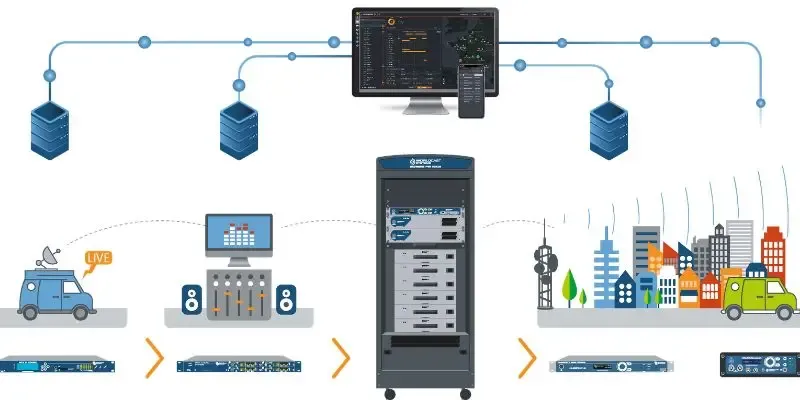
The FM broadcast chain is rarely a single product or a single decision. It's a sequence of connected systems that runs from the studio output through program transport, FM transmission, off-air monitoring, and the supervision layer that ties everything together. Each link has its own performance characteristics, its own failure modes, and its own way of generating data that can either help or confuse the engineering team.
Optimizing this chain isn't only about audio quality. It's about reducing complexity, limiting points of failure, validating what is actually broadcast, and giving both engineers and management a clear view of how the network is performing. Strong FM chains usually share four practical qualities: reliable transport, simplified transmitter sites, real off-air validation, and centralized supervision.
Start with reliable program transport
A solid FM chain starts with dependable program transport between the studio and the transmitter site. This is where many continuity and quality issues appear, and also where good engineering decisions pay off the most.
Most broadcasters today rely on audio over IP (AoIP) or MPX over IP for studio-to-transmitter links. Both approaches can deliver excellent results when paired with proper redundancy, controlled latency, and a stable IP path. The choice often comes down to where the broadcaster wants to handle sound processing and stereo coding.
MPX over IP is increasingly popular because it lets audio processing and multiplex generation happen at the studio, before transport. The transmitter site receives a fully formed composite signal and simply broadcasts it. That reduces the number of units installed at each site, simplifies cabling, and makes remote sites easier to maintain. This matters especially for operators running dozens or hundreds of transmitters across wide geographies.
Whichever transport method is used, the priorities stay the same: redundancy on critical links, predictable latency, error-recovery mechanisms suited to live audio, and clear monitoring of the IP path itself. Transport that "usually works" isn't good enough. Broadcasters need transport whose behavior is understood and measurable.
Reduce failure points with feature-packed FM transmitters
Once the signal reaches the transmitter site, the next optimization opportunity is reducing the number of independent devices in the rack. Modern FM transmitters can integrate functions that used to require separate units, including RDS encoding, sound processing, IP audio decoding, audio backup playback, and full remote-control capabilities.
The benefit goes beyond convenience. Every external device adds cables, power supplies, network connections, and configuration interfaces. Each one is a potential point of failure. A transmitter that handles processing, RDS, and IP decoding internally removes several of those interfaces from the equation. Maintenance gets simpler, troubleshooting is faster because there are fewer suspects, and spare-parts logistics for remote sites become more manageable.
This doesn't mean every site has to use a single integrated unit. Some networks genuinely need dedicated standalone processors or specialized RDS encoders. But where integration makes sense, it usually translates into more robust operation and lower long-term operating costs.